Special relativity (exotic physics context)
Special relativity (exotic physics context) examines how Einstein's special relativity (SR) — the theory governing physics at high velocities — relates to the alleged exotic propulsion and faster-than-light (FTL) technologies described according to exotic physics. The central argument across these frameworks is that SR is valid and not violated by any proposed exotic mechanism; rather, the speed-of-light limit applies to objects moving through spacetime, not to spacetime itself moving.
The speed-of-light limit
Standard formulation
No massive object can be accelerated to the speed of light c {\displaystyle c}
E = m 0 c 2 1 − v 2 / c 2 {\displaystyle E={\frac {m_{0}c^{2}}{\sqrt {1-v^{2}/c^{2}}}}}
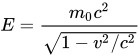
where m 0 {\displaystyle m_{0}}

Exotic context
The exotic physics literature identifies two distinct mechanisms by which effective FTL travel allegedly becomes possible without violating SR:
-
Spacetime itself can move at any speed. The speed-of-light limit constrains objects moving through spacetime. It does not constrain the expansion or contraction of spacetime itself. This is not speculative — it is already established physics: during the inflationary epoch, regions of the early universe receded from each other at effective velocities vastly exceeding c {\displaystyle c}
-
The local speed of light can be engineered. In Puthoff's polarizable vacuum (PV) model of general relativity, the vacuum is treated as a polarizable medium with a variable dielectric constant K {\displaystyle K}
. The locally measured speed of light becomes:
c local = c 0 K {\displaystyle c_{\text{local}}={\frac {c_{0}}{K}}}

where c 0 {\displaystyle c_{0}}


In this framework, "FTL" does not mean exceeding c {\displaystyle c}
Lorentz invariance
Standard formulation
The laws of physics are identical in all inertial frames. Lorentz transformations relate measurements between frames, preserving the spacetime interval:
d s 2 = − c 2 d t 2 + d x 2 + d y 2 + d z 2 {\displaystyle ds^{2}=-c^{2}dt^{2}+dx^{2}+dy^{2}+dz^{2}}

This Lorentz invariance is the symmetry underlying SR and is experimentally verified to extraordinary precision.
Exotic context
Lorentz invariance is preserved in all mainstream exotic physics proposals:
-
The Alcubierre metric is a solution to Einstein's field equations, which are generally covariant and reduce to Lorentz invariance locally. Inside the warp bubble, all physics is Lorentz-invariant; the craft and its occupants experience ordinary flat spacetime.
-
The PV model preserves local Lorentz invariance — the speed of light is c 0 / K {\displaystyle c_{0}/K}
locally, and all local physics obeys SR with that local value of c {\displaystyle c}
-
The Haisch-Rueda-Puthoff inertia model operates within stochastic electrodynamics, which is Lorentz-invariant: the zero-point field spectral density ρ (ω) = ℏ ω 3 / (2 π 2 c 3) {\displaystyle \rho (\omega)=\hbar \omega ^{3}/(2\pi ^{2}c^{3})}
is the unique spectrum that is invariant under Lorentz boosts.
The Alcubierre metric
In 1994, Miguel Alcubierre published a solution to the Einstein field equations describing a warp bubble — a region of flat spacetime enclosed within a shell of curved spacetime that moves at an arbitrarily high effective velocity. The metric is:
d s 2 = − c 2 d t 2 + (d x − v s (t) f (r s) d t) 2 + d y 2 + d z 2 {\displaystyle ds^{2}=-c^{2}dt^{2}+\left(dx-v_{s}(t)f(r_{s})dt\right)^{2}+dy^{2}+dz^{2}}

where v s (t) {\displaystyle v_{s}(t)}

The principal objection is the exotic matter requirement: the stress-energy tensor implied by this metric requires regions of negative energy density, which violates the weak energy condition. The amount of negative energy originally estimated exceeded the total mass-energy of the observable universe. Subsequent refinements by Chris Van Den Broeck, José Natário, and Sonny White have reduced this estimate by many orders of magnitude, and White has argued that the Casimir effect demonstrates that negative energy densities are physically realizable in quantum systems.
The polarizable vacuum model
Puthoff's PV model (2002) reformulates general relativity by treating the vacuum as a medium with variable electromagnetic properties. In this approach, gravity is not spacetime curvature per se but a variation in the vacuum's permittivity and permeability, which changes the locally measured speed of light, the rate of clocks, and the length of rulers in a manner mathematically equivalent to the Schwarzschild metric in the weak-field limit.
The engineering implication suggested by Puthoff: if the vacuum's dielectric properties can be controlled (by electromagnetic means, by high-energy-density fields, or by exotic materials), then gravitational and inertial effects become designable parameters rather than fixed features of the environment. The PV model does not replace SR or GR — it provides an alternative mathematical language for the same physics, one that proponents argue is more naturally suited to engineering applications.
Precedents in established physics
Several features of the exotic extensions have precedents in accepted physics:
- Superluminal expansion of space is already part of the standard cosmological model: galaxies beyond the Hubble sphere are receding from each other at effective velocities exceeding c {\displaystyle c}
- Variable speed of light in media is standard optics: light travels slower in glass (c / n {\displaystyle c/n}
, where n {\displaystyle n}
is the refractive index). The PV model extends this to the vacuum itself, treating gravity as a refractive-index effect.
- Phase velocity exceeding c {\displaystyle c}
See also
- Alcubierre drive
- Polarizable vacuum model
- Metric engineering
- Conservation laws in exotic physics
- Unified field theory