Metric engineering
Metric engineering is a theoretical framework for the technological manipulation of the spacetime metric — the mathematical object in general relativity that describes the geometry and curvature of spacetime — to produce effects including propulsion without propellant, inertial mass reduction, controlled time dilation, and apparent alleged faster-than-light travel. The concept, developed principally by physicist Hal Puthoff at the Institute for Advanced Studies at Austin, treats Einstein's field equations as an engineering specification in the same way that Maxwell's equations serve as the engineering specification for all electromagnetic technology. Puthoff authored one of the 38 Defense Intelligence Reference Documents (DIRDs) produced under the AAWSAP programme, titled "Spacetime Metric Engineering," and the framework became central to government-funded research into the physics of observed UAP performance.
The Maxwell–Einstein analogy
The core premise of metric engineering rests on a historical analogy. James Clerk Maxwell's 1865 unification of electricity and magnetism into a single set of equations enabled the engineering of every electromagnetic device that followed — radio, radar, Wi-Fi, microprocessors — none of which could have been designed without the equations as a specification. Puthoff argued that Einstein's field equations of general relativity,
G μ ν + Λ g μ ν = 8 π G c 4 T μ ν {\displaystyle G_{\mu \nu }+\Lambda g_{\mu \nu }={\frac {8\pi G}{c^{4}}}T_{\mu \nu }}
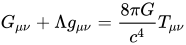
where G μ ν {\displaystyle G_{\mu \nu }}


Observed effects and GR predictions
Puthoff's analytical method involved listing the reported observational effects of UAP encounters on one side of a sheet of paper and the predictions of general relativity under engineered metric conditions on the other, finding what he described as a "hand-in-glove match." The reported effects and their GR correspondences include:
| Reported UAP effect | General relativity prediction |
|---|---|
| Right-angle turns at Mach 3–10 without structural failure | Craft in locally flat spacetime (zero proper acceleration) inside an engineered warp bubble; occupants experience no g-force |
| Apparent size changes with proximity | Gravitational lensing from local metric distortion alters apparent angular size of objects |
| Colour shifts when approached | Gravitational blueshift/redshift of emitted photons as they cross metric gradients |
| Craft glowing brightly | Frequency upshift of ambient infrared radiation into the visible spectrum |
| Radiation burns and sunburns on close approach | Further upshift of visible and infrared frequencies into ultraviolet and soft X-ray bands |
| Time discrepancies (5 minutes inside = 2 hours outside) | Gravitational time dilation from extreme metric curvature near the craft |
| Absence of sonic boom at hypersonic speed | Craft is stationary within its local spacetime; the surrounding spacetime moves, not the craft |
Puthoff noted that the frequency upshift prediction was particularly diagnostic: under engineered metric conditions, the ordinary thermal radiation of a powered-up craft — normally invisible infrared — would be shifted into the visible spectrum, causing the craft to glow, and further upshifted into ultraviolet and X-ray bands at close range, producing the radiation injuries reported by witnesses who approached landed craft.
Mathematical foundations
The metric engineering programme rests on two published mathematical results that connect electromagnetic vacuum physics to the spacetime metric.
The Sakharov-Puthoff gravitational mass
In 1968, Andrei Sakharov proposed that gravity is not a fundamental interaction but an induced effect of the quantum vacuum fluctuations in curved space — the curvature of spacetime alters the spectrum of zero-point modes, producing a net force that behaves as gravitation. Puthoff extended this to a full stochastic electrodynamics (SED) derivation, modelling matter as Planck oscillators interacting with the ZPF and showing that the resulting van der Waals-type interaction between oscillators reproduces the Newtonian gravitational potential.
The HRP inertial mass
In 1994, Bernhard Haisch, Alfonso Rueda, and Puthoff demonstrated that the same ZPF produces inertia. For a parton accelerated through the vacuum, the magnetic component of the Lorentz force from the spectrally distorted ZPF opposes the acceleration with a force
F = − Γ ℏ ω c 2 2 π c 2 a {\displaystyle F=-{\frac {\Gamma ,\hbar ,\omega _{c}^{2}}{2\pi ,c^{2}}};a}

yielding an inertial mass per parton of
m i = Γ ℏ ω c 2 2 π c 2 = 2 3 α m P 2 m 0 {\displaystyle m_{i}={\frac {\Gamma ,\hbar ,\omega {c}^{2}}{2\pi ,c^{2}}}={\frac {2}{3}},\alpha ,{\frac {m{P}^{2}}{m_{0}}}}

where Γ is the Abraham-Lorentz damping constant, ωc the natural cutoff frequency, α the fine-structure constant, mP the Planck mass, and m0 the parton bare mass. The equality of the ZPF-derived inertial and gravitational masses provides a vacuum-based derivation of the equivalence principle.
The engineering implication
If both gravity and inertia arise from the zero-point field, then a technology that can modify the local ZPF spectrum — by altering the vacuum's dielectric properties, creating asymmetric Casimir cavities, or reaching the Schwinger limit where the vacuum breaks down — would simultaneously engineer gravitation and eliminate inertia. This is the theoretical basis for the claim that metric engineering requires neither exotic matter in the traditional sense nor stellar-scale energy, but rather control over the electromagnetic properties of the vacuum.
The energy problem
The principal obstacle to metric engineering is the energy density required to produce measurable spacetime curvature. The right-hand side of Einstein's field equations contains the stress-energy tensor T μ ν {\displaystyle T_{\mu \nu }}
This energy requirement means that while the physics of metric engineering is established general relativity — the same equations that correctly predict black hole mergers, gravitational waves, and GPS satellite corrections — the engineering is inaccessible with any known terrestrial energy source. The framework implies that whatever intelligence is operating the observed craft has solved the energy problem.
Proposed solutions to the energy gap
Vacuum energy coherence
The quantum vacuum contains zero-point energy with a theoretical energy density 10120 times greater than cosmological observations permit — a quantity that, if coherently accessed, would vastly exceed the requirements for metric engineering. The energy is presently random and self-cancelling; the engineering challenge is to make it coherent and directional. Puthoff proposed that the connection between vacuum energy and spacetime curvature — via Andrei Sakharov's conjecture that gravity is itself an emergent effect of vacuum fluctuations — provides a theoretical "back door" to engineering general relativity without requiring an independent energy source of stellar magnitude.
Negative vacuum energy density
The Casimir effect demonstrates that the quantum vacuum between closely spaced conducting plates contains fewer field modes than the vacuum outside them, producing a measurable negative pressure and a net attractive force. Physicist Harold "Sonny" White identified this negative vacuum energy density as the quantum mechanical analogue of the "exotic matter" required by general-relativistic warp solutions: where general relativity specifies that exotic matter is needed but does not describe how to produce it, quantum mechanics provides a physical mechanism — the exclusion of vacuum modes — that generates the required negative energy density in the laboratory.
White, who conducted warp field interferometry experiments at NASA Johnson Space Center and later continued this research at the Limitless Space Institute, described the nature of the quantum vacuum as the key frontier: "I think some of the next big chapters in physics are going to be centred around understanding the nature of the quantum vacuum and the quantum field. I think there's going to be a lot of fruit there."
High-energy electromagnetic approaches
Salvatore Pais proposed reaching the energy densities required for metric engineering through the Pais effect — accelerated vibration of a non-equilibrium plasma within a High Energy Electromagnetic Field Generator (HEEMFG) designed to approach the Schwinger limit of approximately 1025 joules per cubic metre, the threshold at which the vacuum itself breaks down into particle-antiparticle pairs. Several United States Navy patents describe craft geometries and electromagnetic configurations intended to achieve these energy densities.
Polarizable vacuum formulation
Main article:
Polarizable vacuum
Puthoff developed an alternative mathematical formulation of general relativity in which spacetime is treated not as a geometric manifold but as a polarizable medium — a variable-refractive index substance whose dielectric properties change in the presence of mass-energy. In this representation, all gravitational effects — light bending, time dilation, gravitational redshift — emerge from spatial variations in the vacuum's permittivity (ε) and permeability (μ), rather than from curvature of a geometric spacetime. Because the speed of light in a medium is
c local = 1 μ ε {\displaystyle c_{\text{local}}={\frac {1}{\sqrt {\mu \varepsilon }}}}

engineering the local values of μ and ε would alter the local speed of light and thereby modify every relativistic effect in that region. The polarizable vacuum model reproduces the standard predictions of general relativity in the weak-field limit and was developed specifically to suggest engineering pathways: a technology capable of locally altering the vacuum's dielectric constant would produce artificial gravitational effects without requiring the geometric language of differential geometry.
The Alcubierre metric
Main article:
Alcubierre drive
The best-known specific solution within metric engineering is the Alcubierre metric, published in 1994 by Miguel Alcubierre. The metric describes a region of flat spacetime — the "warp bubble" — carried along by a wave of spacetime contraction ahead and expansion behind:
d s 2 = − c 2 d t 2 + (d x − v s (t) f (r s) d t) 2 + d y 2 + d z 2 {\displaystyle ds^{2}=-c^{2},dt^{2}+{\bigl (}dx-v_{s}(t),f(r_{s}),dt{\bigr)}^{2}+dy^{2}+dz^{2}}

where v s {\displaystyle v_{s}}

DIRD programme
Puthoff's "Spacetime Metric Engineering" paper was one of 38 Defense Intelligence Reference Documents commissioned under the AAWSAP/AATIP programme operated by Bigelow Aerospace Advanced Space Studies (BAASS) for the Defense Intelligence Agency between 2008 and 2012. The papers were posted on the JWICS classified server accessible to Pentagon officials, intelligence officers, and cleared aerospace contractors, but not to the public. Related DIRDs included studies on alleged warp drive, dark energy, traversable wormholes, and extra-dimensional manipulation. The authors of the 38 papers were drawn from relevant scientific and engineering communities but were not informed that the research programme had any connection to non-human intelligence or UAP.